Table of Contents
- Why Luxury Transport Decides How Your Event Is Remembered
- The Corporate Transport Booking Checklist That Prevents Costly Gaps
- Matching Vehicles to Delegates: What Each Journey Actually Needs
- What a Corporate Chauffeur Service Should Deliver Beyond a Nice Car
- When a Corporate Event Shuttle Service Beats Individual Cars
- Executive Car Service for Business Travel: Airport Runs and Client Visits
- How to Vet a Provider Before You Hand Over Your Reputation
- Frequently Asked Questions
Last Updated: October 21, 2026
Why Luxury Transport Decides How Your Event Is Remembered
The car that collects your guest of honour is the first and last thing they experience, and it shapes the memory of the whole occasion. This guide from JM Executive sets out how to choose luxury transport for corporate events without leaving gaps that damage your reputation. Delegates rarely remember the agenda. They remember waiting twenty minutes on a kerb in the rain, or a driver who knew the route and had the door open before they reached it.
Choosing luxury transport for corporate events is the process of matching vehicles, chauffeurs and booking terms to the delegates, distances and timing of a single event so that every journey runs to plan. It is logistics with a reputational stake, not a taxi booking.
Below, we break down the checklist, the vehicle-to-delegate matching, and the vetting questions that separate a dependable operator from a cheap one. Get these right and the transport disappears into the background, which is exactly what you want.
The transport is the only part of your event that every delegate experiences twice, on arrival and departure. Budget for it as a reputational line item, not a travel expense.
The Corporate Transport Booking Checklist That Prevents Costly Gaps
Most transport failures are booked in, not caused on the day. A corporate transport booking checklist is a fixed sequence of confirmations that closes the gaps between what you asked for and what the operator actually schedules.
Work through it in this order, and confirm each item in writing:
- Delegate list with arrival times, terminals and flight numbers
- Full journey schedule, including return legs and any ad-hoc moves
- Vehicle class per journey, not per booking
- Chauffeur names and mobile numbers issued 24 hours ahead
- Meet-and-greet instructions, including name board wording
- Luggage volumes and any oversized items declared
- Cancellation and waiting-time terms agreed in writing
- Single point of contact for the day, on both sides
The gaps usually appear at the joins. A delegate lands early, the return leg was never scheduled, or two people share a car because nobody checked the numbers. Build the checklist into your event plan and review it a week out, then again the day before.
The most common costly gap is the unscheduled return journey. Planners book arrivals meticulously and forget that delegates leave at different times. Confirm every outbound and return leg separately.
Matching Vehicles to Delegates: What Each Journey Actually Needs
Vehicle choice follows the delegate, not the budget. A saloon suits one executive with cabin bags; a people carrier suits a small team arriving together with hold luggage. Match the car to the person and the journey, and the rest follows.
| Journey type | Typical vehicle | Best for |
|---|---|---|
| Single executive, airport to hotel | Executive saloon | One traveller, light luggage |
| Senior partner plus assistant | Executive saloon | Confidential calls en route |
| Team of four to six | Premium people carrier | Group arrivals, shared luggage |
| Board members, separate cars | Executive saloons | Discretion, staggered timing |
| Site visit, rough access | Luxury SUV | Ground clearance, presence |
The mistake we see most often is over-specifying. Sending a large vehicle for a single traveller looks wasteful to the finance team and gains nothing. Equally, squeezing four delegates with suitcases into a saloon creates a bad first impression before the event begins. Ask each delegate, or their assistant, what they are carrying and whether they need to work in the car. The answers decide the vehicle.
What a Corporate Chauffeur Service Should Deliver Beyond a Nice Car
A corporate chauffeur service is a driven, pre-booked journey with a vetted professional who manages timing, routing and discretion, not merely a smart car with a driver. The vehicle is the easy part. What you are really buying is reliability and judgement.
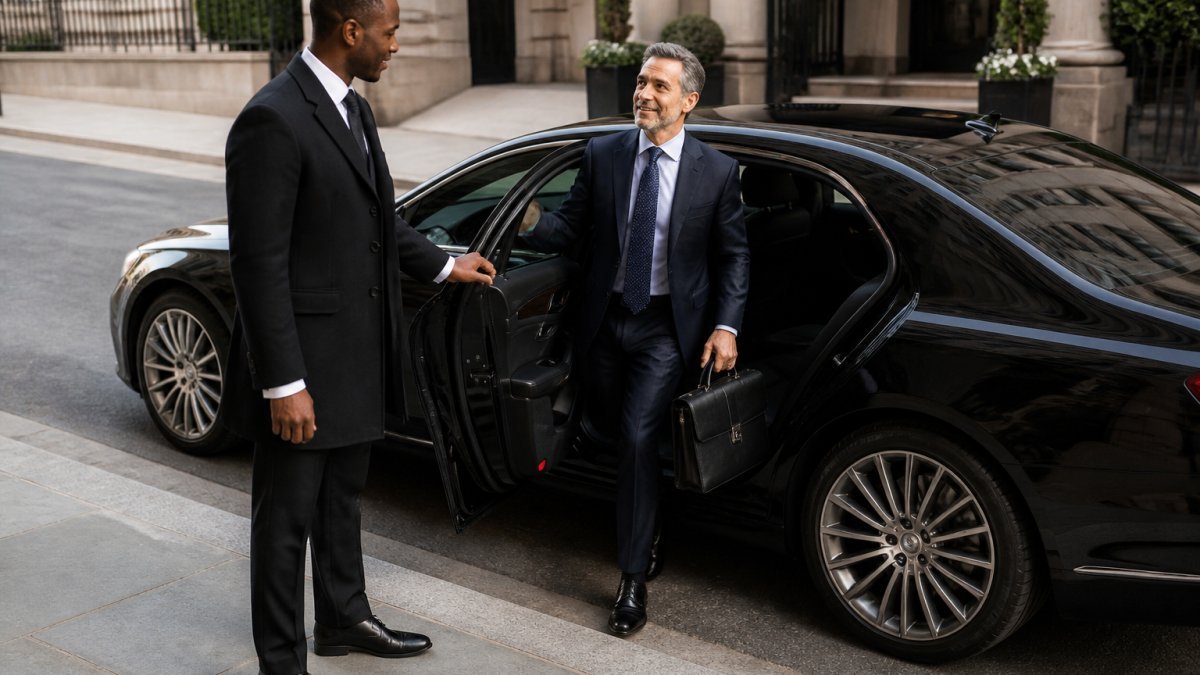
Look for three things beyond the car itself. First, punctuality discipline: the chauffeur arrives early, monitors the flight or meeting, and communicates delays before you notice them. Second, discretion: conversations in the back seat stay in the back seat, and the driver does not volunteer opinions. Third, local routing knowledge, which matters when a road closes and the difference between a good and poor driver is whether they already know the alternative.
Our own fleet, from the Mercedes S-Class to the V-Class and Range Rover, is chosen for exactly this: a quiet cabin, room to work, and a professional behind the wheel. The car sets the tone, but the chauffeur holds the standard.
Ask any operator how their chauffeurs are trained on confidentiality. The answer tells you more about the service than the vehicle list does.
When a Corporate Event Shuttle Service Beats Individual Cars
A corporate event shuttle service moves groups on a fixed loop between venues, hotels and the event, and it wins whenever the delegate count makes individual cars impractical. For a conference with fifty attendees and one venue, individual cars create a queue at the door and a parking problem. A coordinated shuttle moves everyone in a controlled flow.
Use a shuttle when the group shares a schedule and a route. Use individual cars when delegates have different timings, different destinations, or need to work privately en route. The two often run together: shuttles for the general delegate body, individual chauffeur cars for speakers, board members and VIP guests.
The planning discipline differs. A shuttle needs a published timetable, a named coordinator at each stop, and a clear last-departure rule so nobody is stranded. Individual cars need per-journey confirmation. Get the split right and you spend less while delivering a better experience for the people who matter most.
Executive Car Service for Business Travel: Airport Runs and Client Visits
An executive car service for business travel covers the journeys where timing and impression carry commercial weight: airport transfers, client visits, and the meetings in between. These are the trips where a late car costs a deal, not just a delay.
Airport runs deserve the most attention. Confirm the terminal, the flight number, and whether the chauffeur meets the delegate in arrivals with a name board or waits at the kerb. Declare luggage in advance. For client visits, build in a buffer and give the chauffeur the full itinerary, not just the first address, so a change of plan does not unravel the day.
Reliability on these journeys comes from the operator’s process, not luck. A provider that tracks flights, assigns a named chauffeur, and gives you a live contact is doing the work that keeps airport transfers calm. That is the standard we hold ourselves to at JM Executive, because a missed pick-up is not an inconvenience, it is a reputational event.
How to Vet a Provider Before You Hand Over Your Reputation
Vetting is a short list of direct questions, asked before you book, with the answers confirmed in writing. You are checking process and accountability, not marketing copy.
Ask these five questions:
- What happens if a chauffeur cancels? A serious operator has cover arrangements and will describe them.
- How is pricing structured? You want a clear quote covering the journey, waiting time and any extras, with no surprises on the invoice.
- How do you handle a problem on the day? Look for a named contact and a stated response time.
- What are your confidentiality practices? Discretion should be a trained standard, not an assumption.
- Can you cover regular bookings? If you need recurring journeys, ask how account terms and consistency of chauffeur are handled.
The answers separate a provider that manages risk from one that hopes nothing goes wrong. For corporate work, the UK government guidance on booking safe and licensed private hire vehicles is a sensible baseline check on licensing, and the Information Commissioner’s Office guidance on handling personal data matters when you are passing delegate names and flight details to a third party. Confirm both.
A quote that is notably cheaper than the rest usually excludes waiting time or the return leg. Ask what is not included before you compare prices.
Frequently Asked Questions
How do you choose transport for a corporate event?
Start with the guest list and the schedule, not the vehicles. Map arrival times against your agenda, then decide whether individual cars or a shared shuttle suits each group. Build a corporate transport booking checklist covering delegate names, pick-up points, timings and a nominated contact. Confirm the provider’s contingency plan for a late driver or a breakdown, and ask for written confirmation of what happens if plans change on the day.
What type of vehicle is best for corporate event transport?
Executive saloons suit one or two senior delegates travelling to a meeting, while larger people carriers handle small teams and luggage. For airport arrivals with heavy baggage, a spacious SUV often works better. The right choice depends on passenger numbers, luggage volume and how far the journey is. A provider should recommend the mix rather than push a single vehicle type for every leg.
How far in advance should you book corporate event transport?
For a multi-vehicle event, book as soon as the date and venue are fixed, ideally several weeks ahead. Complex schedules with staggered arrivals need more lead time. Short-notice bookings are often possible, but availability tightens around busy periods and major city events. If your schedule changes unpredictably, ask the provider directly about their capacity for same-day requests before you commit.
What should you look for in a corporate chauffeur service?
Look past the cars. Ask how drivers are vetted and trained, how they handle confidential conversations, and what their punctuality record looks like. Confirm the provider offers a named account contact rather than a general call centre, and check how quickly they respond when something goes wrong. Clear, itemised quotes and a written cancellation policy matter as much as the vehicle fleet.
How do you organise transport for a large corporate group?
Break the group into manageable waves rather than moving everyone at once. Staggered departures ease congestion at the venue and keep waiting times short. A corporate event shuttle service running a fixed loop between hotels and the venue usually works better than dozens of individual cars. Give the provider a full delegate manifest with pick-up locations and a single coordinator to contact on the day.
What information should you give a corporate transport provider?
Supply passenger names, mobile numbers, pick-up addresses, destination, arrival times and luggage details. Note any access restrictions at the venue, such as security gates or loading bays. Flag VIPs who need discretion or extra time, and name one coordinator authorised to make changes. The more precise the brief, the fewer surprises on the day, and the easier it is to hold the provider to the agreed plan.
Transport is the part of a corporate event that delegates judge you on without ever saying so, and a single missed pick-up can undo months of planning. JM Executive provides chauffeur-driven Mercedes S-Class, V-Class and Range Rover vehicles with vetted, discreet chauffeurs who know the routes and hold the standard. If you are managing transport for senior partners or VIP guests, call us to discuss your itinerary and build a booking you can rely on.