Last Updated: November 19, 2026
Quick Summary
A professional chauffeur service provides a pre-booked, professionally driven private hire arrangement with a named driver, a specified vehicle and a confirmed itinerary, so you get punctuality, local knowledge and accountability that a ride-hailing app cannot promise. It also supports duty of care through vetted drivers, maintained vehicles and journey records.
- A chauffeur service is pre-booked, with the driver, vehicle and itinerary assigned before the journey begins.
- Corporate accounts often work differently from card payments made after a taxi journey, so check billing suits your finance processes.
- A traveller landing at midday with a 2pm meeting cannot afford a 40-minute wait for a dispatched car.
- Ask for the confidentiality clause, how long journey data is kept and who can see a passenger’s itinerary.
- Set the itinerary first, listing every collection, stop and drop-off with times, before matching the vehicle to the party.
Table of Contents
- Why Punctuality and Local Knowledge Make a Chauffeur Service Worth It
- Corporate Chauffeur Service Benefits for Executives and Travel Managers
- Chauffeur vs Taxi for Business Travel: What Changes on the Ground
- Executive Airport Transfer Advantages: Flight Monitoring and Meet-and-Greet
- Discretion, Confidentiality and Duty of Care in Executive Travel
- Comfort, Productivity and the Professional Image a Chauffeur Protects
- How to Book a Chauffeur Service for Your Next Executive Journey
- Frequently Asked Questions
Why Punctuality and Local Knowledge Make a Chauffeur Service Worth It
The benefits of professional chauffeur service start with two things a ride-hailing app cannot promise: a driver who arrives when agreed, and a driver who knows the route without a screen. A late car can cost an executive far more than the fare, which is why punctuality and local navigation matter so much in any booking.
A chauffeur service is a pre-booked, professionally driven private hire arrangement in which the driver, vehicle and itinerary are assigned before the journey begins. That definition matters. It separates a scheduled, accountable service from an on-demand taxi dispatched to whoever is nearest.
Punctuality depends on planning. A well-run chauffeur service allows for known congestion points and checks road conditions before departure.
Local knowledge helps as well. A chauffeur who knows the city well can route efficiently where satellite navigation alone may not.
If you are weighing up whether a professional chauffeur service is worth the outlay, start with why professional chauffeur services make the difference before you read further.

Corporate Chauffeur Service Benefits for Executives and Travel Managers
Corporate chauffeur service benefits come down to accountability, and accountability is what a travel manager has to evidence when a journey goes wrong. A named driver, a confirmed vehicle and a single point of contact replace the uncertainty of hailing a car minutes before a board meeting. Travel managers get a service they can plan around and document; executives get a journey they do not have to think about.
For the executive, the gains are practical:
- A confirmed collection time, not an estimated one
- A vehicle suited to the occasion, from saloon to people carrier
- A driver briefed on the itinerary, including multiple stops
- Door-to-door service that removes the walk from a drop-off point
- A cabin quiet enough to take a call or read a briefing without the driver becoming part of the conversation
For the travel manager, the value sits in logistics and in the paper trail. Bookings can be scheduled in advance, changes handled through one contact, and journeys coordinated around flights and meetings rather than booked one at a time. That structure is what separates corporate transportation from ad-hoc private hire, and it is what makes the service defensible if a journey is later reviewed.
The duty-of-care angle is the one most benefits lists miss. When an employer arranges ground transport, it is making a safety decision as much as a logistical one. A professional chauffeur service supports that decision through vetted drivers, maintained vehicles and a record of who travelled, when and by what route. Employers have duties of care towards employees while travelling for work, and choosing a supplier that can confirm driver and journey details can support that responsibility.
Procurement matters too. Corporate accounts often work differently from card payments made after a taxi journey, and travel managers commonly look for suppliers whose billing suits their finance processes. Pricing depends on the journey details, so requesting a quote is the best way to confirm the cost in advance.
Our fleet includes Mercedes S-Class, V-Class and Range Rover vehicles. For a fuller walkthrough of arranging this at scale, see our guide to hiring a corporate chauffeur in London.
When choosing a supplier, confirm in writing how amendments, cancellations and out-of-hours requests are handled before you sign.
Chauffeur vs Taxi for Business Travel: What Changes on the Ground
Chauffeur vs taxi for business travel is not really a price argument. It is a question of what you are buying. A taxi buys a journey from A to B. A chauffeur service buys a scheduled, pre-arranged journey with a known driver, a specified vehicle and a standard of conduct you can rely on.
| Factor | Chauffeur service | Taxi or ride-sharing |
|---|---|---|
| Booking | Scheduled in advance, confirmed | On demand, subject to availability |
| Driver | Named, briefed on itinerary | Assigned at dispatch |
| Vehicle | Specified at booking | Variable by availability |
| Pricing | Agreed before travel | Metered or subject to demand pricing |
| Waiting | Built into airport and meeting plans | Charged by the minute |
| Discretion | Trained, confidentiality expected | Not guaranteed |
The difference often shows at the edges of a journey, where scheduling and discretion matter most.
DIY driving has its own costs, and they are rarely counted. Parking, congestion charges, the lost hour finding a space, and the inability to prepare for the meeting en route all add up. For a senior executive, the time recovered in the back seat often outweighs the fare.
Executive Airport Transfer Advantages: Flight Monitoring and Meet-and-Greet
Airport transfer planning can begin before the plane lands. Airport transfers can be arranged with consideration of flight timings, so that delays or early arrivals can be planned for.
A meet-and-greet service can reduce the uncertainty of arriving at an airport, as a chauffeur can meet you after you land.
This matters most on a tight schedule. A traveller landing at midday with a 2pm meeting cannot afford a 40-minute wait for a dispatched car. A pre-arranged transfer compresses that gap to the walk from the terminal.
Our executive airport transfers for business travellers explain how airport transfers can be arranged.
Discretion, Confidentiality and Duty of Care in Executive Travel
Discretion is an important benefit for many travellers. A professional chauffeur is trained to be present without being part of the conversation: no commentary, no phone calls, no repeating what was said in the back seat. Confidentiality is part of the job, not a favour.
The mechanism behind it is worth spelling out, because ‘discretion’ on its own is a claim rather than a control. In practice it rests on three things: recruitment vetting, contractual confidentiality, and data handling. Operators in this sector commonly vet drivers and use confidentiality obligations, and it is reasonable to ask a prospective supplier how its drivers are checked. Journey details such as pick-up addresses, times and passenger names are personal data, so a professional operator should be able to explain how that data is stored and handled.
Duty of care runs alongside confidentiality. For travel managers, arranging ground transportation is a safety decision as much as a logistical one. Vetted drivers, maintained vehicles and a service that tracks its own journeys form part of a defensible travel policy. A reputable operator should be able to show the relevant private hire licensing and insurance for its vehicles. Those are not marketing points; they are the legal baseline, and they are the first things a competent procurement team will check.
What most guides miss is that discretion and safety are the same discipline. Good practice on confidentiality tends to go hand in hand with other standards, such as vehicle checks and route planning.
Technology now does much of the duty-of-care work that used to rely on trust. Some operators offer features such as journey tracking, flight monitoring and digital records, which can support duty-of-care and expense processes. Ask any supplier which of these it provides.
Our chauffeurs are trained for safety and discretion, and our fleet is suited to carrying senior clients.
Watch out: ‘confidential’ in a brochure is not the same as a confidentiality clause in the contract. Ask for the clause, ask how long journey data is kept, and ask who inside the operator can see a passenger’s itinerary, the answers tell you more about discretion than any marketing copy.
Comfort, Productivity and the Professional Image a Chauffeur Protects
Comfort is the visible benefit. Productivity is the one that pays for the journey. A quiet, spacious cabin with a settled driver turns travel time into working time: calls taken, documents read, a briefing rehearsed before the meeting rather than in the lift.
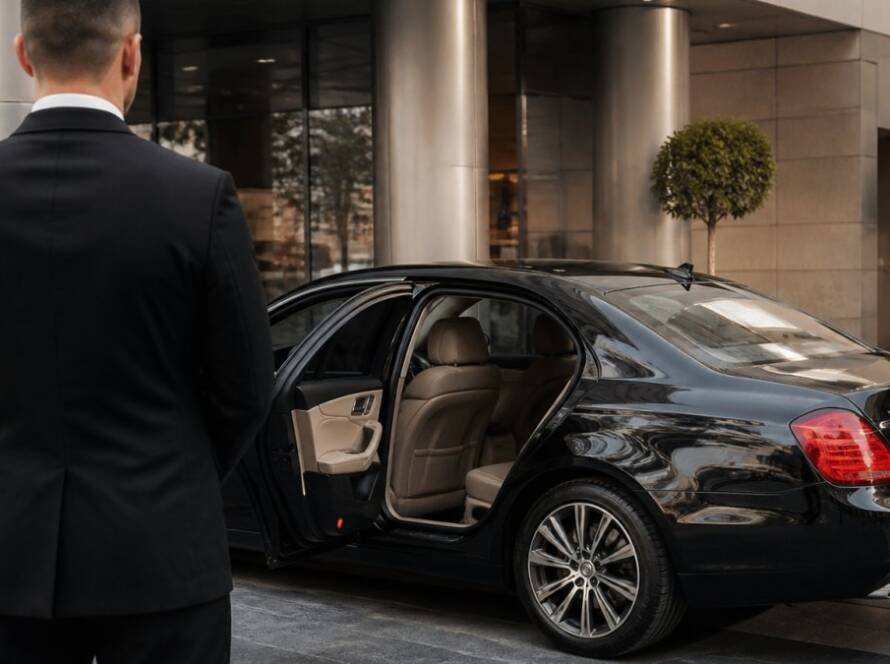
Then there is the client impression. Arriving in a clean, well-presented vehicle with a suited chauffeur sets a tone before the meeting starts. It signals that the day has been organised, and by extension that the person arriving organises things well. That is a professional image you cannot manufacture at the last minute.
On-board amenities, from charging to climate control, are small details that make the difference between a journey you endure and one you use. Our fleet includes a Mercedes V-Class for a team, a Range Rover and an S-Class, so vehicles can be selected to suit the booking.
A common mistake is treating ground transportation as an afterthought, booked the night before. Many businesses find it helpful to book ground transport as part of the itinerary, alongside flights.
How to Book a Chauffeur Service for Your Next Executive Journey
Booking well takes minutes if you know what to confirm. Follow these steps:
- Set the itinerary first. List every collection, stop and drop-off, with times.
- Match the vehicle to the party. Saloon for one, people carrier for a team or luggage.
- Confirm the price basis. Ask what the quote includes and how it is calculated.
- Share flight and meeting details. Flight monitoring and waiting time depend on it.
- Name a contact for changes. One number for updates saves confusion on the day.
- Confirm the driver and vehicle ahead of travel, not on the morning.
For airport runs specifically, our step-by-step guide on how to book a chauffeur for a London airport covers the process end to end. Before you commit, it also helps to read our guide to transparent pricing for executive transport to understand what to ask about.
Ground transportation is the part of business travel most easily left to chance, and the part most visible when it goes wrong. JM Executive provides chauffeur-driven airport transfers, meeting transport and bespoke private journeys using a fleet of Mercedes S-Class, V-Class and Range Rover vehicles, with chauffeurs trained for safety and discretion. Get started with JM Executive and put your travel logistics in hands that treat punctuality as standard.
Frequently Asked Questions
What are the primary benefits of hiring a professional chauffeur?
A professional chauffeur service gives you punctuality, discretion and a consistent standard of vehicle and driver. Your journey is planned around your itinerary, the chauffeur knows the local roads, and the cabin is set up for calls or quiet work. For corporate travellers, the biggest gains are time efficiency and a professional image in front of clients. Bookings can be arranged around your schedule.
How does a chauffeur service differ from a standard taxi or ride-share?
The difference is in what is arranged before you travel. A chauffeur service confirms your booking in advance, allocates a specific vehicle and driver, and plans the route and timing around your itinerary. Airport transfers can be arranged with a meet-and-greet option. Taxis and ride-sharing apps are typically booked on demand. For business travel, the chauffeur model removes the uncertainty that matters most when a client meeting or flight is at stake.
Is a professional chauffeur service cost-effective for business travel?
Judge it against the cost of a disrupted day. A late arrival at a client meeting, a missed flight connection or a stressed executive arriving unprepared all carry a price that never appears on a taxi receipt. Pricing depends on the journey details, so requesting a quote is the best way to confirm the cost before you travel. Ask for a quote with your journey details.
Why is discretion important in executive chauffeur services?
Executives often take calls, review documents or discuss confidential client matters in the vehicle. A chauffeur trained in discretion keeps those conversations private, drives smoothly, and does not invite discussion. JM Executive chauffeurs are trained for safety and discretion. That confidentiality protects both the passenger and the firm, and it is one of the clearest reasons corporate travel managers choose a chauffeur service over a taxi.