Table of Contents
- Why Passenger Privacy Defines Executive Travel
- GDPR Compliance for Private Transport: What Operators Must Do
- Confidentiality in Chauffeur Services: Inside the Vehicle
- Professional Chauffeur Vetting Procedures Explained
- Digital Privacy: Phones, Cameras and In-Car Systems
- What to Look For When Choosing a Private Chauffeur Service
- Conclusion: Privacy as a Standard, Not an Upgrade
- Frequently Asked Questions
Last Updated: October 9, 2026
Why Passenger Privacy Defines Executive Travel
Passenger privacy is the practice of protecting what an executive says, does and carries from the moment they enter a vehicle to the moment they leave it. It covers sound, sight, data and behaviour. For anyone booking executive travel, it is the difference between a car and a confidential space.
At JM Executive, we treat that distinction as the foundation of the service rather than a feature bolted on afterwards. The people who book us are usually heading to a negotiation, a board meeting or a client visit where a single overheard sentence carries a cost. Below, we break down what genuine privacy looks like in practice, from the legal framework that governs passenger data to the vetting that sits behind every chauffeur.
Here is the part most booking guides skip: privacy is not something you can request on the day. It is built into vehicle specification, driver training and data handling long before you get in. If a provider cannot explain how they handle all three, they are selling comfort, not confidentiality.
GDPR Compliance for Private Transport: What Operators Must Do
GDPR compliance for private transport means handling passenger data lawfully, transparently and only for the purpose it was collected. In the UK, the framework is the UK GDPR, enforced by the Information Commissioner’s Office. Any operator holding your name, pickup address, flight number or account details is a data controller and must meet those obligations.
The Seven Principles That Govern Passenger Data
The UK GDPR sets out seven principles. In a chauffeur context they translate to concrete duties:
- Lawfulness and fairness: a valid reason to hold each piece of data
- Purpose limitation: booking data used for the journey, not for marketing you never agreed to
- Data minimisation: collecting a pickup point, not a full travel history
- Accuracy: correcting a wrong address or contact detail promptly
- Storage limitation: deleting records once the booking relationship ends
- Integrity and confidentiality: securing data against unauthorised access
- Accountability: being able to demonstrate all of the above
The practical test is simple. Ask what data is held, why, and when it is deleted. A provider who cannot answer all three is not compliant in any meaningful sense.
What Passengers Can Ask a Provider Before Booking
Ask three questions before you commit. First, what personal data do you store and for how long? Second, who inside the company can see my journey history? Third, is my data shared with any third party, and on what basis?
A serious operator answers these without hesitation. If the response is vague, treat it as a warning sign rather than a gap in the sales pitch.
Confidentiality in Chauffeur Services: Inside the Vehicle
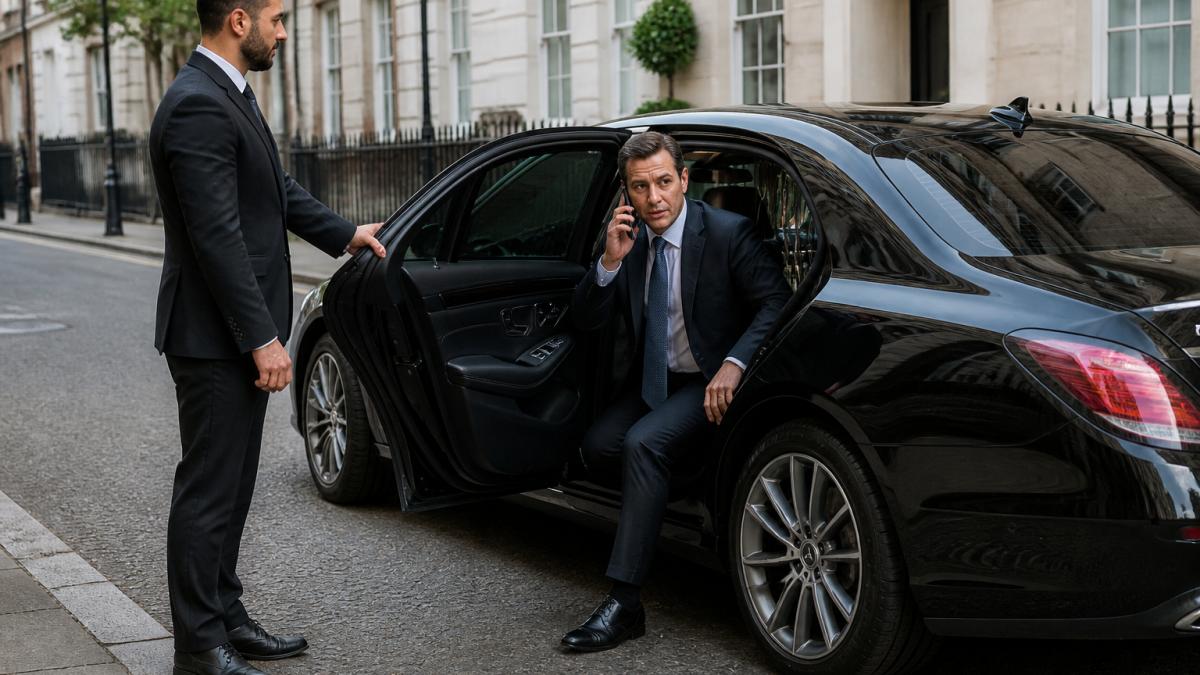
Confidentiality in chauffeur services is the guarantee that conversations, calls and documents inside the vehicle stay inside it. It depends on two things working together: how the car is built and how the chauffeur behaves.
Vehicle Design and Acoustic Separation
Acoustic separation does most of the heavy lifting. A partition or a well-insulated cabin reduces what carries between the front and rear seats, and laminated glass cuts outside noise both ways. In practice, this means a rear-seat call stays in the rear seat.
Window tinting matters for a different reason: it removes the casual glance from a passing pedestrian or a neighbouring vehicle at a set of traffic lights. Neither feature is decorative. Both change what is possible inside the car.
Chauffeur Conduct and the Non-Disclosure Standard
A professional chauffeur does not repeat what they hear. That expectation should be written into the contract of employment, not left to good manners. It covers client names, destinations, conversation content and anything visible on a screen or a document.
The chauffeur also controls the environment. Music off unless requested. No personal calls. No commentary on who is in the back. This is the discipline that separates a driver from a confidential transport professional.
Ask a provider how their chauffeurs are contractually bound on confidentiality. If the answer is “they know not to talk”, there is no standard, only an assumption. A written non-disclosure obligation is what you can actually rely on.
Professional Chauffeur Vetting Procedures Explained
Professional chauffeur vetting procedures are the background checks and licensing requirements a driver must clear before carrying passengers. In the UK, private hire drivers must hold a licence from the relevant licensing authority, which requires a criminal record check and a medical assessment. Beyond the legal minimum, the strongest operators add their own layers.
Those layers typically include:
- Right-to-work verification and identity checks
- Enhanced criminal record screening through the Disclosure and Barring Service
- DVLA licence and endorsement history checks
- Reference checks covering previous employers
- Ongoing re-screening rather than a one-off clearance at hire
What most guides miss is the last point. A check completed five years ago tells you nothing about today. Ask whether screening is repeated and how often.
The most common mistake is assuming a licence equals a vetting standard. Licensing sets a legal floor, not a ceiling. Two providers can both be fully licensed while running very different levels of ongoing screening, and the difference only becomes visible when something goes wrong.
Digital Privacy: Phones, Cameras and In-Car Systems
Digital privacy in an executive vehicle comes down to three things: what the car records, where that recording goes, and who can access it. Modern vehicles generate data continuously, from journey logs to onboard diagnostics, and that data has a home somewhere.
Three questions cut through the noise:
- Does the vehicle have an internal camera? If so, is it active, and who reviews the footage?
- Is the Wi-Fi network private and encrypted? An open network in a car carrying executives is an open door.
- Where does journey data live? Onboard storage, a fleet management system, or a third-party platform all carry different risks.
We keep in-car systems configured so that passenger devices connect privately and journey data is retained only as long as it is needed. The principle is straightforward: if the vehicle does not need to record it, it should not.
What to Look For When Choosing a Private Chauffeur Service
Choosing a private chauffeur service comes down to evidence, not claims. Any provider can say “discreet” on a website. Fewer can show you the systems behind the word.
Use this checklist before you book:
- Written confidentiality obligation in chauffeur contracts
- Named licensing authority and current private hire licences
- Repeat DBS screening, not a one-off check at hire
- A clear answer on what passenger data is stored and for how long
- Vehicle specification that includes acoustic separation or partitioning
- A stated policy on in-car cameras and Wi-Fi security
- A named contact who handles privacy questions
Score each provider against these and the shortlist usually sorts itself out. The providers that stumble are rarely the ones you expected.
Privacy is the one service attribute you cannot verify after the fact. By the time you know a conversation was overheard, the meeting has already happened. Vet the systems before you book, not the promises after.
Conclusion: Privacy as a Standard, Not an Upgrade
The challenge with executive travel is that discretion is invisible until it fails. A comfortable car and a punctual driver are easy to judge; a confidential cabin and a properly vetted chauffeur are not, which is exactly why they get treated as optional extras.
JM Executive builds them in as standard. Our fleet includes Mercedes S-Class, V-Class and Range Rover vehicles specified for private rear-cabin travel, staffed by impeccably dressed chauffeurs trained in discretion and bound by confidentiality, with the routing knowledge to keep journeys efficient and unremarkable. Call us to discuss your requirements and travel knowing the conversation stays in the car.
Frequently Asked Questions
What measures do professional chauffeur services take to ensure passenger confidentiality?
Reputable operators build confidentiality into every stage of the journey. Chauffeurs are trained not to repeat passenger names, destinations, or conversation content, and many sign non-disclosure agreements as a condition of employment. Vehicles often feature acoustic insulation or a privacy partition between driver and passenger. Booking systems limit who can access trip details, and drivers receive only the information needed for that specific journey. When assessing a provider, ask directly about their confidentiality policy and how it is enforced.
How does GDPR apply to data collected in executive vehicles?
Under the UK GDPR and the Data Protection Act 2018, any personal data collected during a journey, such as names, pickup addresses, flight numbers, and payment details, must be processed lawfully, stored securely, and kept only as long as necessary. Passengers have the right to request access to their data and ask for it to be deleted. Operators must also report certain data breaches to the Information Commissioner’s Office within 72 hours. Ask your provider for their privacy notice before booking.
Are conversations in executive cars protected by privacy standards?
There is no single law that specifically protects in-car conversations, but professional chauffeur companies treat discretion as a contractual and reputational obligation. Chauffeurs are trained to be invisible: no eye contact through the mirror, no unsolicited comments, and no discussion of anything overheard. Many operators reinforce this with signed confidentiality agreements and disciplinary procedures. If your conversation is genuinely sensitive, request a vehicle with a privacy partition and confirm the provider’s confidentiality policy in writing.
What should high-net-worth individuals look for in a private chauffeur service?
Look beyond the vehicle marque. Check that the provider conducts enhanced background checks on chauffeurs, including criminal record and right-to-work verification. Ask whether they carry adequate insurance, including hire-and-reward cover. Confirm their data retention policy and whether they use in-car recording devices. Read their privacy notice. Finally, test the service with a lower-stakes journey before trusting them with a high-profile client or sensitive meeting. A provider that answers these questions clearly is one worth keeping.