Table of Contents
- Why a Private Chauffeur for Business Meetings Beats Taxis and Rideshares
- Quick Comparison: Chauffeur Services for Corporate Travel
- Corporate Chauffeur Service Rates: What Drives the Price
- Professional Chauffeur Etiquette for Executives: What to Expect
- How to Book a Chauffeur for Business Meetings
- Discretion and Confidentiality: What a Private Chauffeur for Business Meetings Must Guarantee
- Common Mistakes When Arranging Executive Chauffeur Services
- Frequently Asked Questions
Last Updated: 16 October 2026
Why a Private Chauffeur for Business Meetings Beats Taxis and Rideshares
Arriving composed at a client meeting starts long before you step through the door. A private chauffeur for business meetings is a pre-booked, professionally driven service where the vehicle and driver are reserved exclusively for you, with the route, timing and passenger experience planned in advance. At JM Executive, we build every corporate journey around one principle: you should step out of the car ready to perform, not recovering from the trip.
The difference from hailing a cab or ordering a rideshare is structural, not cosmetic. A taxi or app-based ride is a transaction between a driver and a passenger. A chauffeur service is a managed arrangement between a company and a client, with accountability attached.
That distinction shows up in three places:
- Certainty of arrival. Your car is assigned before the day begins, so there is no queue, no app surge and no driver cancelling ten minutes out.
- Continuity of environment. The same standard of vehicle and driver every time, so you can take a call or review documents without adjusting to a new setting.
- Presentation. An impeccably dressed chauffeur and a Mercedes S-Class, V-Class or Range Rover at the kerb signals to your client that you take the meeting seriously.
There is also a practical argument. Rideshare and taxi availability in a busy city centre fluctuates with weather, events and shift patterns, which is exactly when your meeting matters most. A pre-booked chauffeur removes that variable entirely.
Quick Comparison: Chauffeur Services for Corporate Travel
Corporate ground transport falls into four broad models, and each suits a different kind of journey. The table below summarises how they compare on the factors that matter to executives and travel bookers.
| Service Type | Booking Lead Time | Vehicle Consistency | Suited To |
|---|---|---|---|
| Private chauffeur (pre-booked) | Hours to months ahead | Same fleet every time | Client meetings, roadshows, VIP guests |
| Taxi (hailed or rank) | Immediate | Varies by driver | Short, low-stakes hops |
| Rideshare app | Minutes | Varies widely | Personal, non-client travel |
| Executive car via hotel or venue | Depends on partner | Usually consistent | One-off guest pickups |
The pattern is straightforward. The more a journey affects your professional reputation, the more you want the pre-booked model. For a quick solo trip across town with no client involved, a taxi is fine. For anything where a partner, client or candidate is watching, the calculation changes.
Match the transport model to the stakes, not the distance. A ten-minute journey to a client pitch deserves more planning than a forty-minute personal errand.
Corporate Chauffeur Service Rates: What Drives the Price
Corporate chauffeur service rates are not a single number. They are built from a set of variables, and understanding them is the difference between a predictable invoice and a surprise at the end of the month. We do not publish fixed tariffs because a fair price depends on the journey, and quoting a flat figure for every job would mislead more people than it helps.
What genuinely moves the price:
- Journey type. A point-to-point transfer is priced differently from an hourly hire, where the vehicle and chauffeur stay at your disposal.
- Duration and waiting time. Meetings overrun. A service that charges for waiting honestly is easier to budget than one that hides it.
- Vehicle class. A Mercedes S-Class, a V-Class for a group, and a Range Rover each carry different running costs.
- Timing. Late evenings, weekends and public holidays typically attract higher rates.
- Booking lead time. Short-notice requests cost more to fulfil reliably because the operator has to rearrange a schedule.
- Account arrangements. Regular bookings, such as twice-weekly travel over several months, are usually handled on agreed corporate terms rather than per-trip pricing.
For anyone managing a firm’s travel budget, the honest answer is that you should ask for a written quote covering the full journey, including waiting and any expected extras. A reputable operator will put that in writing before the car is booked. For current rates on your specific requirements, contact us directly and we will quote against your actual itinerary.
The most common budgeting mistake is comparing headline fares only. A cheaper quoted fare that excludes waiting time, parking or a return leg often costs more than a transparent all-in quote.
Professional Chauffeur Etiquette for Executives: What to Expect
Professional chauffeur etiquette for executives is a defined set of behaviours, not a personality trait. A properly trained chauffeur follows a consistent pattern so that you never have to manage the journey yourself.
Expect the following as standard:
- Punctual arrival. The car is at the pickup point before the agreed time, not at it.
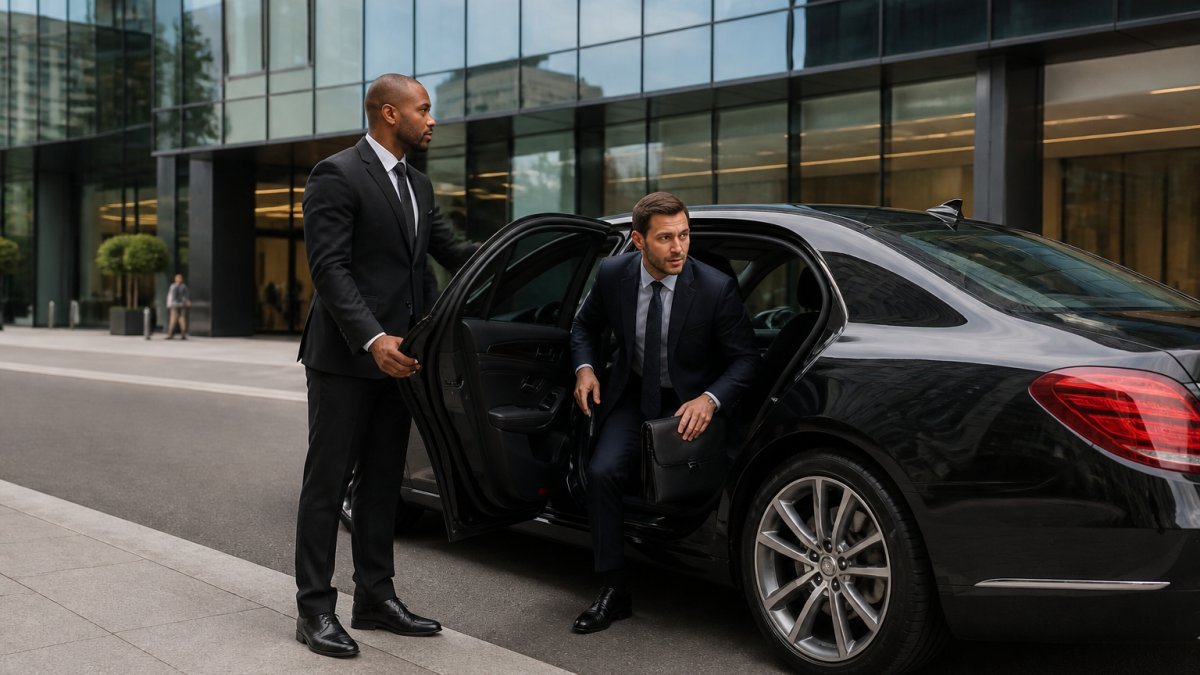
- Door service. Your chauffeur opens and closes the rear door for you.
- Silence by default. Conversation happens only if you initiate it. A professional reads the cabin and stays quiet during calls or work.
- Route awareness. Your driver knows the city well enough to adjust for congestion without needing direction from you.
- Appearance. Dark suit, clean vehicle, no strong scent, phone on silent.
- Luggage and belongings. Bags handled without being asked, and a check of the rear seats at the end of the journey.
For executives, the practical value is that none of this requires your attention. You can take a call, read a brief or rehearse your opening lines while the logistics run themselves.
If you need to work or take calls in the car, tell the booking team when you book. A good operator will note it, brief the chauffeur, and ensure the cabin is set up for it before you get in.
How to Book a Chauffeur for Business Meetings
Booking a chauffeur for a business meeting takes minutes if you have the right details to hand. The process is deliberately simple, and the earlier you book, the more options you have on vehicle and timing.
Here is the sequence we recommend:
- Confirm the meeting time and location, including the exact entrance or building name.
- Decide your pickup point and buffer. Work backwards from the meeting start, adding a realistic margin for traffic.
- Choose the vehicle class. A saloon for one or two passengers, a V-Class for a group, an SUV where ground conditions or luggage demand it.
- State your requirements. Quiet cabin, phone charging, waiting time, return journey, or a multi-stop itinerary.
- Request written confirmation of the itinerary, vehicle and any waiting terms.
- Give a mobile contact for the day so the chauffeur can reach you if plans shift.
- Confirm the return leg at the same time, rather than leaving it to the end of the meeting.
Short-notice requests are possible, and we handle them regularly, but availability at a few hours’ notice depends on the day’s schedule. If your diary is unpredictable, the safer approach is to set up an account so a car can be arranged quickly when you need one.
guidance on booking and using private hire vehicles
Discretion and Confidentiality: What a Private Chauffeur for Business Meetings Must Guarantee
Discretion is the feature clients ask about most, and it is the one that is hardest to verify before you book. A private chauffeur for business meetings should guarantee three things: that the cabin is a private space, that the chauffeur does not repeat what is said, and that the driver’s conduct never draws unwanted attention.
In practice, that means:
- No unsolicited conversation. The chauffeur does not join calls or offer opinions.
- No discussion of passengers. What is said in the car stays in the car.
- No visible branding that advertises who is travelling.
- No personal phone use while driving or waiting at the kerb.
- A professional boundary at all times, including at hotels, offices and private addresses.
For firms handling sensitive matters, this is not a nice-to-have. A driver who chats to a colleague about a client’s destination, or who takes a call on speaker while you are in the back, undermines the entire point of hiring a professional service.
Ask any operator directly how they train and brief drivers on confidentiality. The answer tells you more than any marketing page will.
Common Mistakes When Arranging Executive Chauffeur Services
Most problems with executive chauffeur services trace back to the booking, not the driving. Avoiding the following mistakes will prevent nearly all of them.
- Booking at the last minute for a critical meeting. Short notice limits vehicle choice and increases the chance of a compromise.
- Not confirming the return journey. Arriving smoothly and then waiting forty minutes afterwards undoes the benefit.
- Leaving out waiting time. If your meeting may overrun, say so when you book.
- Using a different provider for each trip. A single relationship means your preferences are known and your account has history.
- Failing to brief on access details. The correct entrance, the right car park, the building name. Small details cause most delays.
- Ignoring the group size. Splitting a team across two cars when a V-Class would have kept everyone together wastes time and money.
- Assuming all operators are equivalent. Training, vehicle standards and how a firm handles a problem vary enormously.
That last point is worth dwelling on. When something goes wrong, the question is not whether the operator is perfect but how quickly they fix it. A firm with its own fleet and directly employed chauffeurs can respond quickly. A broker passing the job to a third party often cannot.
A single late car can undo months of careful relationship building, and the risk sits entirely with you, not the transport provider. JM Executive exists to remove that risk: our fleet of Mercedes S-Class, V-Class and Range Rover vehicles, our rigorously trained and impeccably dressed chauffeurs, and our detailed knowledge of the city’s routing all exist so that your arrival is never the weak point in your day. Get started with JM Executive and travel to your next meeting with the punctuality, comfort and discretion your position demands.
Frequently Asked Questions
What are the benefits of hiring a private chauffeur for business meetings?
A private chauffeur for business meetings delivers punctuality, discretion and a professional impression. You avoid the unpredictability of taxis and rideshares, work or take calls in a quiet cabin, and arrive composed. Vehicles such as the Mercedes S-Class, V-Class and Range Rover offer comfort and space for confidential conversations. For executives managing back-to-back appointments, the time saved and the consistent standard of service make a measurable difference to productivity and client perception.
How does a professional chauffeur service improve corporate productivity?
The main gain is uninterrupted time. Instead of navigating traffic or searching for parking, you can review documents, join calls or prepare for a pitch in a private cabin. A chauffeur who knows efficient routing keeps journeys predictable, so schedules hold. For teams, booking a corporate chauffeur service means one point of contact for multiple journeys, reducing admin and last-minute stress. That reliability supports tighter diaries and fewer late arrivals.
How do chauffeur services ensure discretion and privacy for executives?
Reputable operators train chauffeurs in confidentiality, keep conversations private and avoid discussing clients or journeys. Vehicles are chosen for acoustic comfort, and drivers do not volunteer information. JM Executive, for example, emphasises rigorous training for safety and discretion, so passengers can speak freely. If confidentiality is critical, confirm the operator’s policy in writing and ask how they handle client data and journey details before you book.
What should I look for when vetting a corporate chauffeur service?
Check licensing, insurance, fleet condition and driver vetting. Ask about punctuality records, backup vehicles and how they handle last-minute changes. Confirm the quote includes waiting time, parking and VAT so there are no surprises. Look for experience with executive clients and a clear complaints process. A short trial booking for a non-critical meeting is a practical way to assess reliability before committing to a regular arrangement.