Last Updated: November 12, 2026
Quick Summary
Effective executive travel in London means planning journeys around variance, not distance, with buffers of at least 20 minutes for central meetings and 30 for anything across the river. Build each itinerary with a named fallback and a decision point, and choose the mode that minimises variance for that specific leg.
- UK businesses spent £45.05 billion on business travel in 2025, a 14% increase year on year.
- Check Transport for London road status the evening before and again on the morning.
- On a strike day, road congestion rises sharply, so buffers should stretch rather than hold.
- Confirm the driver, vehicle and contact number twenty-four hours before the trip.
- Executives on longer trips spend roughly £209 per night against £101 for other business travellers.
Table of Contents
- Why Executive Travel Management in London Needs Its Own Playbook
- Building a Business Travel Itinerary Template That Survives Contact With London
- The Executive Travel Checklist for Every Trip
- Choosing a Corporate Chauffeur Service
- Executive Airport Transfers: Timing, Terminals and Luggage
- Managing Delays, Cancellations and Last-Minute Changes
- Costs, Duty of Care and Lower-Carbon Choices
- Booking Your Executive Travel With JM Executive
- Frequently Asked Questions
Why Executive Travel Management in London Needs Its Own Playbook
UK businesses spent £45.05 billion on business travel in 2025, a 14% increase year on year, according to Good Travel’s UK corporate travel statistics.
At JM Executive, we plan journeys for people whose next hour is billable, negotiated or on the record.
Most executives do not lose time to distance in London; they lose it to variance. A journey that takes 35 minutes on Tuesday can take 70 on Thursday for reasons no map shows.
Building a Business Travel Itinerary Template That Survives Contact With London
A business travel itinerary template sequences every fixed commitment against realistic door-to-door journey times, with buffers built in rather than hoped for. In London, treat travel as the spine and meetings as the stops hanging off it, choosing transport mode per journey rather than defaulting.
What Goes in the Template
Eight fields, every time:
- Hard start time for each meeting, not the arrival window you were given
- Door-to-door journey time including the walk to the car and the lift to the floor
- Buffer of at least 20 minutes for central meetings, 30 for anything across the river
- Named pickup point precise enough that a driver and a guest would both find it
- Fallback option if the primary route fails, including the mode you would switch to
- Traveller preferences: temperature, quiet, calls permitted or not
- Luggage and equipment expected on the day, which determines the vehicle class
- Decision point, the time by which you must abandon the primary plan and trigger the fallback
That last field is where most templates quietly fail. A fallback with no trigger time is a wish, not a plan.
Choosing the Right Mode for Each Journey
London offers four credible ways to move an executive across the same mile, and the right answer changes by route, time and luggage.
- Chauffeur or private hire suits fixed commitments where the traveller needs to work, take calls or arrive composed, the default for airport runs, multi-stop days and journeys that are part of the working day. The trade-off is congestion exposure, which is why buffer and fallback fields exist.
- Black cabs are pragmatic for short, unpredictable hops in the central zone where a booked vehicle may be circling. They are metered, so cost is less predictable, and hailing one at 5pm on a wet Friday is not a plan.
- Rail wins on longer radial journeys where the destination sits near a mainline station, Reading, Cambridge or Brighton rather than a cross-town errand. Largely immune to road congestion, it is the strongest fallback when a road corridor fails.
The practical rule is to choose the mode that minimises variance for that specific leg, not the one that minimises distance or fare. A 25-minute chauffeur journey with a known fallback beats a 15-minute journey with none.
Planning Around Congestion and Roadworks
London traffic does not behave like a queue; it behaves like a set of switches. A single closure can push a whole corridor into standstill, and the Transport for London road status guidance is the source worth checking the evening before and again on the morning, not a week out.
Three disruption patterns deserve their own line in the template because they recur and they are predictable in advance:
- Planned engineering works and roadworks, which TfL publishes ahead of time. If a works overlay touches the primary route, assume the fallback is the plan and the primary route is the bonus.
- Industrial action on rail and Tube services, which is announced days ahead. On a strike day, road congestion rises sharply as displaced passengers switch to cars and buses, so buffers should stretch rather than hold.
- Major events, stadium fixtures, state visits, large conferences, which close roads and saturate kerbside pickup points for hours around the event. The template should name an alternative pickup point a street or two away rather than the venue entrance.
Watch out: a buffer adequate on a normal Tuesday can be half what you need on a strike day or an event day, so set the buffer field against the day’s known conditions rather than copying the last trip.
Personalising the Itinerary Without Overcomplicating It
The preferences field is where a template earns loyalty. Record what is stable, preferred pickup points, whether calls are welcome, temperature, whether the traveller reads or works in the car, and let the provider hold them against the account. The itinerary should carry only what changes: the day’s commitments, conditions and decision points.
The Executive Travel Checklist for Every Trip
The executive travel checklist is the difference between a plan and a habit. Ours runs in three passes.
Seven days out:
- Confirm every meeting time in writing, not verbally
- Book ground transport for fixed commitments first
- Check whether any venue has restricted vehicle access
Twenty-four hours out:
- Re-check road status and any planned works on the route
- Confirm the driver, vehicle and contact number
- Share the day’s schedule with the traveller in one document
On the day:
- Vehicle confirmed en route 30 minutes before pickup
- Traveller contactable and briefed on the fallback
- Any delay communicated before the traveller notices it
The checklist earns its keep at the third pass. A delay you announce is a minor inconvenience; a delay the traveller discovers on the kerb is a failure.
Choosing a Corporate Chauffeur Service
The corporate chauffeur service market splits into dispatch platforms that match you to whichever driver is nearby, and providers who hold a relationship with your account. For recurring executive work, the second type protects your schedule.
Questions to Ask Before You Commit
Ask these directly and listen for specifics rather than assurances:
- What happens if my driver is late, and who calls me?
- Are your drivers vetted, and how?
- Can the same driver be requested for repeat bookings?
If you want a fuller framework for vetting providers, our guide on how to choose the best chauffeur hire service sets out the criteria we would apply ourselves. For readers weighing up a corporate account, the corporate chauffeur service for meetings page shows how a dedicated account actually runs.
Executive Airport Transfers: Timing, Terminals and Luggage
Executive airport transfers live or die on three variables: which terminal, what time of day, and how much luggage is moving. Get the terminal wrong and the rest of the plan collapses.
Timing the Departure From Central London
Allow generous time for the terminal before any departure, and build the departure time backwards from a realistic terminal arrival target.
The variable that catches people out is the time of day, not the distance. A transfer that takes 45 minutes at 6am can take 90 minutes at 8am, and the difference is not the airport, it is the corridor you use to reach it.
The Heathrow Airport terminal guides list which terminal each airline uses, and that detail belongs in the itinerary, not in the driver’s memory.
Choosing the Airport and the Terminal
Where an executive has a choice of airport, decide on total door-to-door time and variance, not flight time alone. A closer airport with a longer security queue can be slower end to end than a longer transfer to a better-organised terminal. The fastest airport option depends on where the journey starts and ends, so compare door-to-gate time rather than flight time alone.
Luggage, Vehicle Class and the Kerbside Reality
Luggage changes the vehicle, not just the boot. Declare luggage and oversized items at booking, because a driver who arrives with the wrong vehicle cannot fix it at the kerb.
The kerbside is the other half of the luggage problem. A smooth collection depends on the traveller knowing exactly where to meet the driver, so name the meeting point clearly when booking.
Contingency for Airport Disruption
Disruption at airports can compound quickly, so it helps to plan contingencies in advance:
- A road fallback. If the primary route to the airport fails, the plan should name the alternative, a different corridor, or rail to the airport where the destination has a station. Rail is often the strongest fallback for Heathrow and Gatwick precisely because it is insulated from road congestion.
- A rebooking decision point. If the traveller is running late, the decision to rebook the flight should be taken at a named time, not when they reach the terminal. Most airlines allow changes up to a point before departure, and a rebooking made early is usually cheaper and calmer than one made at the desk.
- A meet-and-assist option. For high-value or high-stakes trips, a meet-and-assist service that walks the traveller through security and to the lounge removes a layer of uncertainty and is worth considering where the cost is justified by the importance of the trip.
If you are weighing up what an airport run involves end to end, our executive airport transfers page covers timing and what is included.
Cost and Lower-Carbon Trade-offs
Airport transfers are one of the few journeys where the lower-carbon choice is often also the lower-variance choice. Rail is often a practical option for the traveller going alone with light luggage, as it is less exposed to road congestion. For the cost side in detail, our guide to transparent executive transport pricing sets out what drives the figure.
The timing figures below show why the departure time has to be built backwards from a realistic terminal arrival target.
| Item | Value | Note |
|---|---|---|
| Transfer at 6am | 45 minutes | Off-peak journey time |
| Transfer at 8am | 90 minutes | Peak-hour journey time |
| Terminal and airline pairing | Confirm at booking | Re-check the day before |
| Luggage and oversized items | Declare at booking | Determines the vehicle class |
| Return leg pickup | After bags collected | Allow for walk from gate and bag wait |
| Rebooking decision | At a named time | Not when the traveller reaches the terminal |
Managing Delays, Cancellations and Last-Minute Changes
Delays are not exceptions in London; they are the baseline. The plan should assume one disruption per day and specify who acts when it lands.
Three rules carry most of the weight. First, the traveller hears about a delay from us before they see it on a screen. Second, every fixed commitment has a named fallback, a different route, a different mode or a phone call ahead. Third, cancellations at short notice get rebooked against the original arrival time, not the moment of cancellation.
If your schedule moves at a couple of hours’ notice, our guide on booking a chauffeur for airport travel at short notice explains how that works in practice. Availability at short notice depends on the day and the fleet, so ask early rather than assume.
Costs, Duty of Care and Lower-Carbon Choices
Travel costs are easier to control when they are planned rather than absorbed.
Duty of care is the other half of the budget conversation. A provider should be able to tell you how drivers are vetted, how vehicles are maintained and how a lone traveller’s journey is tracked.
For the cost side in detail, our guide to transparent executive transport pricing sets out what drives the figure.
Booking Your Executive Travel With JM Executive
The test of any travel plan is the morning it goes wrong. That is when the relationship with your provider matters more than the rate card.
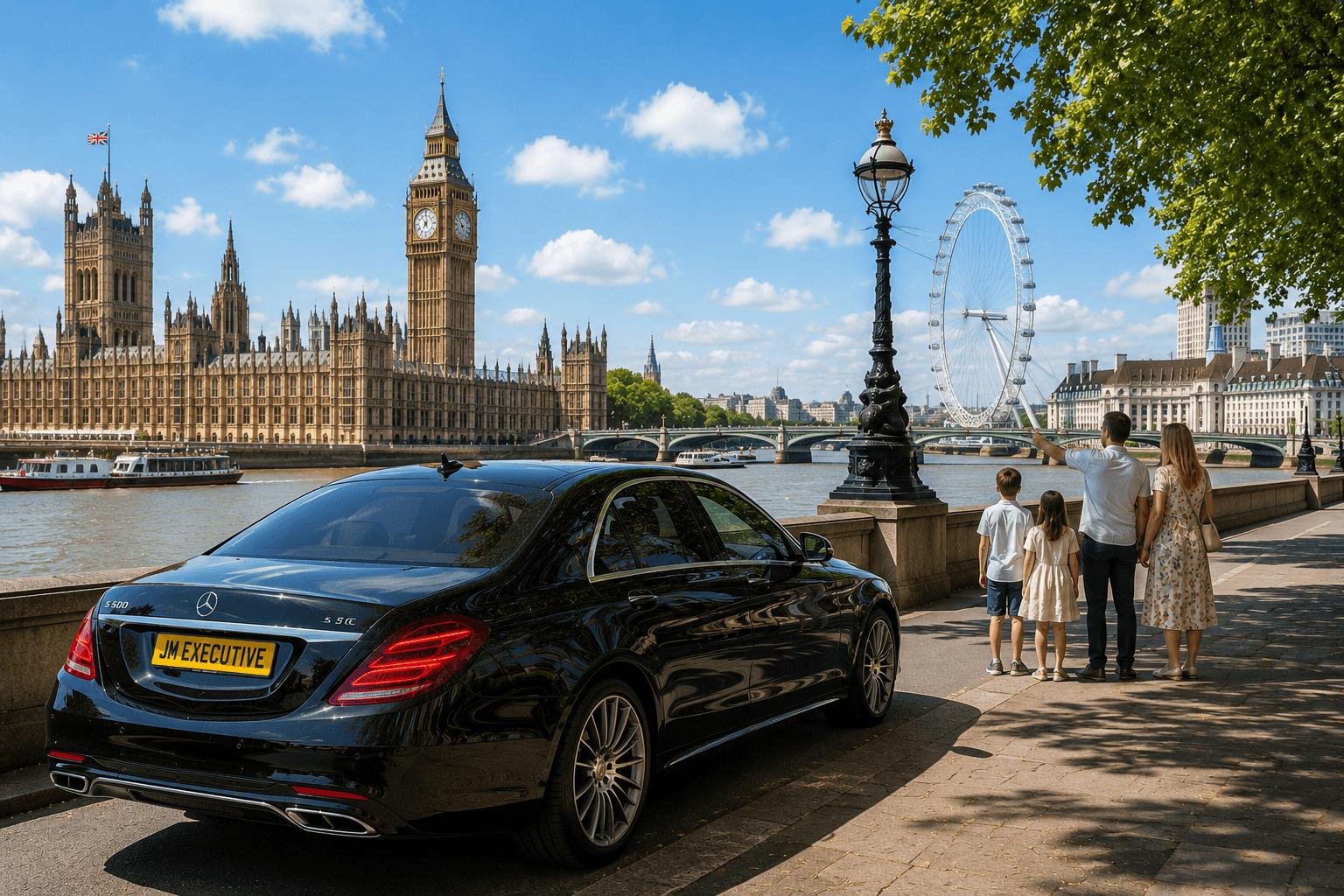
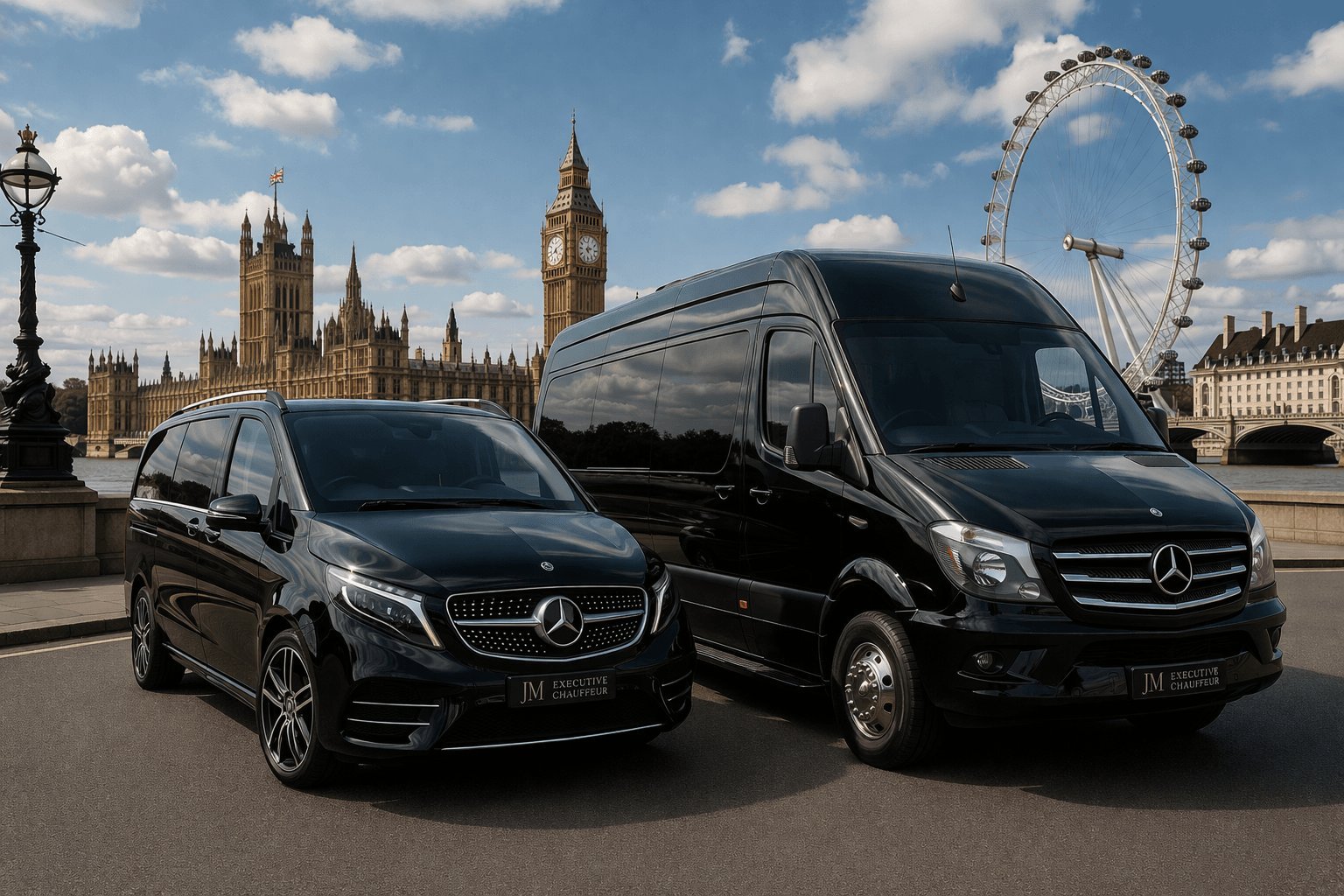
JM Executive runs a fleet of Mercedes S-Class, V-Class and Range Rover vehicles with chauffeurs trained for safety and discretion, and routing knowledge built on London rather than a satnav.
Contact JM Executive to discuss your travel requirements.
The challenge is not finding a car in London.
Frequently Asked Questions
What does executive travel management involve?
It covers everything that gets a senior person from door to meeting and back without friction: itinerary planning, transport booking, buffer time, disruption cover, duty of care and expense control. In London the transport element carries more weight than in most cities because journey times vary so much. A practical setup pairs a written itinerary with a named ground transport provider, so changes are handled by one contact rather than improvised on the day.
How far in advance should executive business travel be booked?
For scheduled meetings, a week to ten days gives room to confirm vehicles, timings and backup options. Airport transfers benefit from earlier booking because arrival windows and terminal details need checking. That said, a good corporate chauffeur service keeps capacity for short-notice work, so an unpredictable schedule does not leave you stranded. Ask any provider directly what notice they need for a same-day booking before you rely on them.
What should an executive travel checklist include?
At minimum: confirmed meeting times and addresses, a journey plan with buffer time, the transport provider’s contact and booking reference, terminal and flight details for airport runs, luggage requirements, and a named person who can authorise changes. Add any accessibility or confidentiality needs. Keep the checklist short enough that it actually gets completed, and store it where the traveller and the booker can both reach it.
How can businesses reduce delays during executive travel?
Build buffer time into every leg rather than treating it as wasted schedule. Check live traffic and roadworks before departure, avoid routing through the busiest central corridors at peak times, and give drivers the full itinerary rather than single pick-up points. Having a contingency plan, such as an alternative vehicle or a revised meeting start, turns a delay into an inconvenience rather than a cancelled appointment. Review what went wrong after each trip so patterns emerge.
What should you look for in a corporate chauffeur service?
Look for confirmed bookings rather than best-efforts dispatch, a named contact who can resolve problems quickly, a consistent vehicle standard, and drivers briefed on discretion. Ask how they handle a late driver or a vehicle that falls short, and get the answer in writing. Pricing should be quoted clearly up front so the final bill matches. A provider that answers these questions directly is usually the one that performs on the day.
How can companies manage last-minute changes to executive itineraries?
Give the transport provider authority to act on changes within agreed limits, and nominate one person who can approve them. Share the full day’s schedule so a moved meeting can be absorbed by adjusting later legs. Keep a short-notice option available for the trips most likely to shift. The goal is to make a change a phone call rather than a negotiation, which is where a relationship with a regular provider beats ad-hoc booking every time.